Skip to content
MSMRentals
HomesCollectionsJournalFor homeownersContact
English·Español·Deutsch
MSM

The lights are on.
You are expected.

hello@msmrentals.com
MSMRentals
  • Homes
  • Collections
  • Journal
  • For homeowners
  • Contact

© 2026 MSM Rentals · The Mediterranean · Privacy · Terms

We don’t simply manage homes.

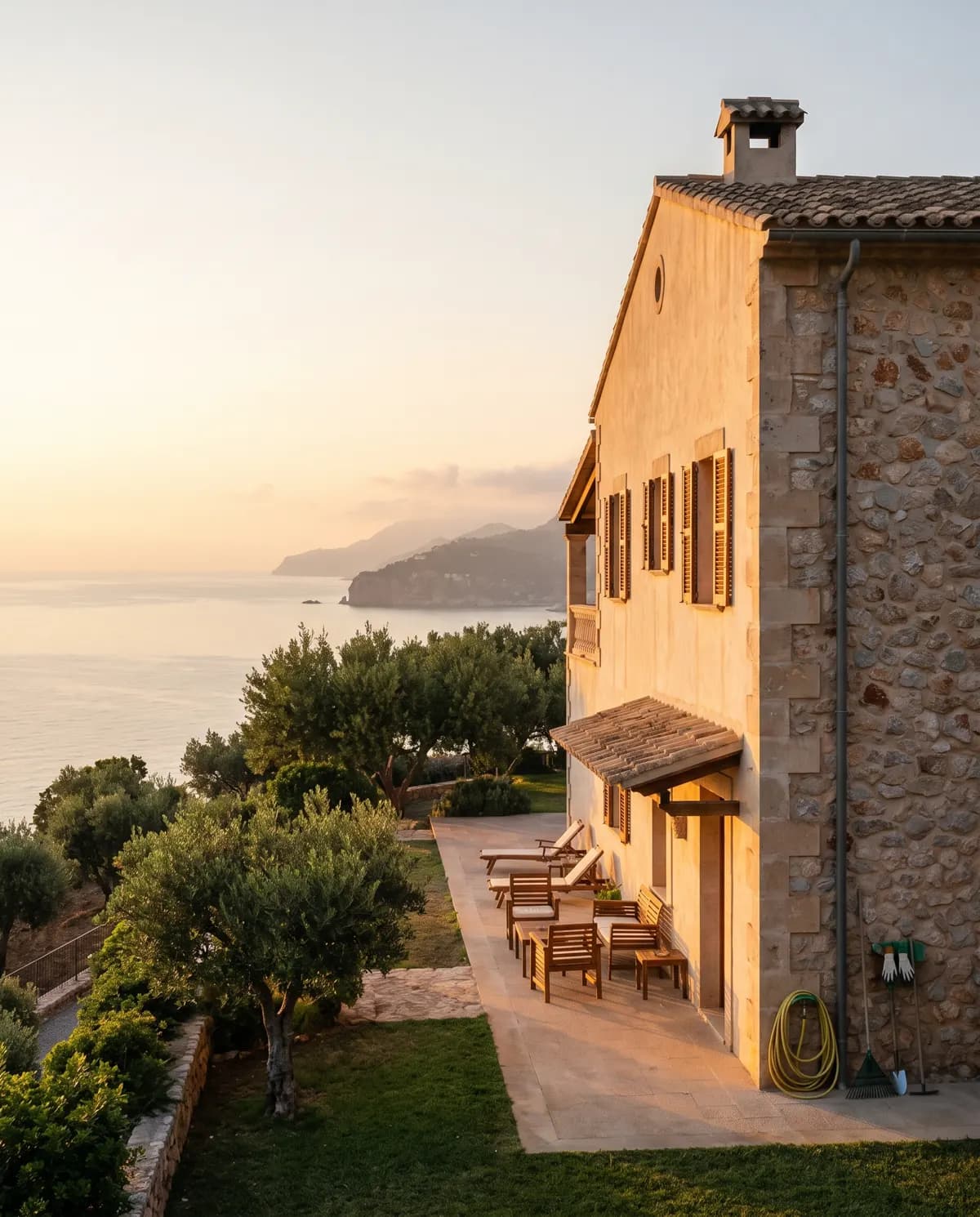
A coastal home at golden hour, its windows warmly lit as evening comes

For owners of Mediterranean vacation homes

You believe you are choosing someone to manage your home.

The decision you are actually making is larger than that. It is a matter of representation.

Most owners come with practical questions first. Who will look after the home. Who will be there when it matters. Who can be trusted with the keys to a place that holds more than its value.

They are fair questions. They deserve honest answers.

But they are not the first question.

To manage a home is to provide a service. It can be scheduled, measured, and — if you wish — compared on price. Many companies offer it. Some are good at it.

To represent a home is something else.

It is to take responsibility for how your home is seen, how it is experienced, and how it is remembered — by people you will never meet, in your absence, under your name.

It is the difference between a house that is looked after, and a home that is spoken for.

To us, your home is not a line in a portfolio — because it is not one to you.

It is the light you know at a certain hour. The choices you made in every room. The place a particular summer happened.

A guest who arrives meets all of that — or meets a version of it that someone handled carelessly. What your home is understood to be, long after a stay has ended, becomes its reputation.

That reputation becomes yours. And it becomes ours. We do not take it on lightly, and we do not leave it to chance.

This is why we do not measure ourselves against the companies that manage homes for the least.

We do not compete to be the cheapest company managing a home.
We compete to become the best company representing it.

So the choice in front of you is not which service to buy. It is who you trust to represent one of the most valuable things you own — valuable not only in what it is worth, but in what it means.

Which is also why we cannot say yes to every home.

The standard

We say no more often than we say yes.

Not to appear selective, and not because a home is unworthy of the love someone has for it — every home is worthy of that. We decline for a reason that has nothing to do with how much we might like to work with you, and everything to do with what representing a home asks of us.

Every home we take on carries the reputation of every home already in our care.

A guest disappointed by one residence does not simply leave one impression. They leave with a quieter conclusion — about what our name means, and so about every other home that shares it. That is why we cannot choose without thinking of who is already here.

We are selective on behalf of people already with us, and people not yet with us —

  • the homeowners who trusted us before you, and are owed the standard they were promised;
  • the homeowners who will come after you, who inherit whatever standard we keep today;
  • the guests who return, expecting exactly what our name has told them to expect;
  • and every residence already in our care, whose standing rises and falls with the company it keeps.

A standard that protected no one would only be vanity. Ours exists to protect something real.

When we decline, we tell the owner why — truthfully, and plainly. Not a vague apology, but the real reason.

And often the answer is not no, but not yet. A home can be closer than its owner believes, held back by a few specific things that could be changed. When that is true, we say so, and we say what they are. What an owner does with that is theirs to decide — with us, or without us.

We would rather give an owner an honest answer they did not want than an easy one we did not mean.

Saying no has a cost. Every home we decline is one we might have represented, and there are companies that would take each of them without a second thought. We are not one of those companies.

When the choice is between something to gain now and what our name will be worth for years, we choose the name. A reputation is slow to build and quick to spend — and it is the one thing we cannot be careless with, because it does not belong only to us. It belongs to everyone who has trusted it.

So the question we are asked most — will you accept my home? — is not quite the right one.

Before any important decision about a home, we ask ourselves something simpler:

Would we genuinely choose to stay here, exactly as it is today, and recommend it without hesitation to someone we love?

We ask it on behalf of the guest the home is meant for. If the answer is not yet yes, we do not ask how to present the home more cleverly. We ask what would make it true.

That is the whole of the standard. Not a door held open or shut, but a question a home can be brought to answer.

Which leaves the question worth asking. Not whether we would say yes —
but what your home would need, to deserve the answer.

And if it did?

Three levels of representation

If your home were accepted, what happened next would depend entirely on the home.

Some homes ask to be looked after well and told honestly. Some carry a story that wants drawing out. A very few are, already, everything our name means. A home is represented as deeply as it genuinely is — no more, so that nothing is exaggerated; no less, so that nothing is left unsaid.

Every home we take on has already met the standard — we do not represent homes we would not choose to stay in ourselves. So the care beneath all of this is the same care, always.

What changes from one home to the next is not how much it is worth to us, nor how much of our attention it is given, but how much of a story it has — and how far that story can honestly be carried.

We are the ones who judge that, the way we judge everything: on behalf of the guest the home is meant for, and said to you plainly, whichever way it falls.

For most homes, that means being represented simply and completely — presented truthfully, cared for entirely, held to everything the name requires. This is a home Managed by MSM, and there is nothing modest in it: it is the promise every MSM home keeps.

Some homes have more to say. A place whose setting, history or spirit gives it a character of its own is told more singularly — not because it is worth more, but because the home itself asks for it. A home like that becomes an MSM Signature.

And a few homes are, without qualification, everything the name promises. These are the homes of the MSM Collection — the fullest expression of what we do, and the smallest circle we keep.

The Collection cannot be pursued.

It is not a place a home is sent, or a standing an owner can ask for. A home is never admitted to the Collection; it is recognised as already belonging there — on the day the answer to a single question becomes an unhesitating yes: would we choose to stay here ourselves, exactly as it is, and recommend it without reservation to someone we love?

Nothing else opens it — not a request, not a preference, not anything offered in exchange. That is what makes it worth belonging to, and what keeps faith with every home already inside it. A circle anyone could enter would be worth entering to no one.

You will not have to decide which of these your home is. We will tell you — honestly, whichever it turns out to be.

It may be less than you hoped, or more than you expected. Either way you will hear the truth; either way your home will be represented completely, and will remain entirely its own. We bring the standard and the frame. The character stays the home’s.

What we cannot tell you yet is everything your home might become — only what it is today, and what, with honest work, it could grow into.

But a name is only a name until you see what stands behind it.
So — this is what representation actually looks like.

What representation looks like

Representation is made of four crafts. How a home is seen. How it is felt on the day someone arrives. How it is kept across the years. And how, through all of it, it stays entirely itself.

A contemporary white coastal villa in late-morning light, its pool edge meeting the sea

How a home is seen

Presentation

You have seen the listings that flatter a home into something it is not — the angle that hides the road, the light that was never that gold. A guest who books one of them arrives already a little disappointed, before they have set down their bag.

We show a home as the place it actually is. Not the smallest version of it, and never a grander one — the true one. The measure we hold to is plain: a guest should arrive to a little more than we promised, and never to less.

Sheer linen curtains breathing at open doors, the room cool against the bright afternoon

How a home is felt on arrival

Welcome

When that guest arrives, the home is ready. Any competent company can make a home ready.

What we care about is harder to arrange: that the guest feels expected. The difference is small and unmistakable — a home that has been prepared, and a home that has been prepared for you. It is why a house can be spotless and still feel as though no one had you in mind, and why a simpler home can feel like arriving somewhere you were awaited.

That feeling is not produced by a system. It is produced by people who decided it mattered.

A restored stone house with an arched doorway holding cool shade, steps worn smooth

How a home is kept over the years

Stewardship

A home does not hold its condition on its own. Left alone it quietly slips; used carelessly, faster. Cared for properly, it can do the opposite — end a season in better order than it began.

We treat what is within our control as ours to improve, not only to maintain. Sometimes that means saying the uncomfortable thing: that something needs attention now, while it is small, rather than later, when it is not. A home in our care should be handed back better than it came to us — not as a promise about every outcome, which no honest company can make, but as the way we hold ourselves while it is ours.

A modern house of oak and glass, its cedar deck running toward calm water

How a home stays itself

Identity

Through all of this, one thing never happens: your home does not become ours.

We bring a standard and a way of doing things, and we hold every home to it. But a standard is a frame, not a template. We do not press homes into a single house style, interchangeable and forgettable. The things that make your home itself — the way one room takes the afternoon, the particular reason you chose it — are exactly the things a guest should carry away. People should remember where they stayed, not only the country they were in.

A home we represent is still, unmistakably, yours. That is the whole reason to represent a home rather than replace it.

Four crafts, one home.

Seen truthfully, felt on arrival, kept for the years, and never made into anything other than itself. That is what we mean by the word — not a claim, but these.

You have seen now how we would speak about your home to a guest: honestly, and with care.
Which leaves a fair question — how would we speak to you?

What we will tell you

We will tell you the truth — the good, and the uncomfortable.

Most companies promise to communicate well. What they usually mean is that they will keep you informed — updates when you want them, answers when you ask. That is worth having. It is not what we mean.

We mean candour: the truth about your home, in full, whether or not it is welcome, and whether or not you thought to ask for it. Being kept informed is something arranged for you. The truth is something owed to you — and the distance between those two is the whole of this.

It is easy to be honest about good news. Every company manages that.

Candour is measured by the other kind — the quieter conversation no one enjoys beginning. That your home did not do as well this season as the last. That something you love about it has begun to wear. That the advice you were hoping for is not the advice we have to give.

You will hear those from us early, and without having to go looking for them.

So, a few things you can expect from us, without exception.

  • When your home is doing well — so that you know it, and know why.
  • When it is not — before it becomes a surprise, while there is still time to act.
  • When it needs investment to stay what it is, or to become more — said honestly, even when the easier thing would be to say nothing.
  • And when we are the ones who got something wrong.

That last one matters most, because it is the one a company can most easily keep to itself.

When a mistake is ours, we will tell you it was ours — not dressed up, not folded into a longer story, not left for you to find. We will tell you what happened. Then we will put it right.

We do this for a plain reason. A home’s reputation, and ours, is worth more than any single piece of news we might prefer you didn’t hear — and a truth you learn from us is worth more than the same truth learned from anyone else. Reputation is not protected by managing what an owner is told. It is protected by our being the ones who tell them.

None of this begins the day you sign, and none of it ends there. The honesty we offer before there is any agreement between us is the same honesty you will have every year after it.

Because what we are really offering an owner is not a service, and not information about a service. It is the truth about your home — told to you first, told to you straight, and told to you whether or not it flatters us.

That is the one thing you cannot secure simply by asking for it. It can only be given, by people who have decided to.

If you believe that — and it is fair to want it shown rather than promised — then there is very little left to be wary of.

Which leaves one last question, and it is a beginning rather than a doubt: how do we start?

The first visit

It begins with a visit.

It asks nothing of you, and commits you to nothing — a first visit is simply a chance for both of us to see whether this is right. Not a form, not a quotation, not a decision made on the strength of a website. Before anything else, we come and see the home — and we talk. That is the whole of the first step. Everything that might follow depends on it, and nothing is asked of you before it.

A first visit is not us presenting to you, and not you auditioning for us. It is both of us trying to answer the same question, honestly: is this the right home for the way we work, and are we the right people for this home?

We will look at your home the way we look at every home we consider — on behalf of the guest it is meant for, asking whether we could genuinely represent it as it deserves. You will be looking at us, deciding whether we are what these pages have said we are.

Both matter equally. Neither of us should agree to this unless both are true.

Because it is mutual, it can end in no — from either side, and without discomfort.

We may conclude that we are not the right company for your home; if so, we will tell you plainly, and why. You may conclude that we are not the right company for you, and you will owe us no explanation at all.

A first visit that ends in an honest no is not a failure. It is the same standard that protects every home already with us, working exactly as it should.

The sun meeting the Mediterranean, its gold path laid across calm water

So there is nothing to sign, and nothing to buy. There is only a conversation to be had — when you would like to have it.

If, after everything here, you would like us to see your home, write to us and tell us a little about it. We will arrange to visit, and we will begin the way we intend to continue: honestly, without pressure, and on your time.

Write to us

You came to this page thinking about who might manage your home.

We hope you leave it thinking about something larger: who should be trusted to represent it — and to tell you the truth about it — for as long as it is in their care.

When you are ready to begin that conversation, we will be here. Take the time you need. The decision deserves it, and so does your home.